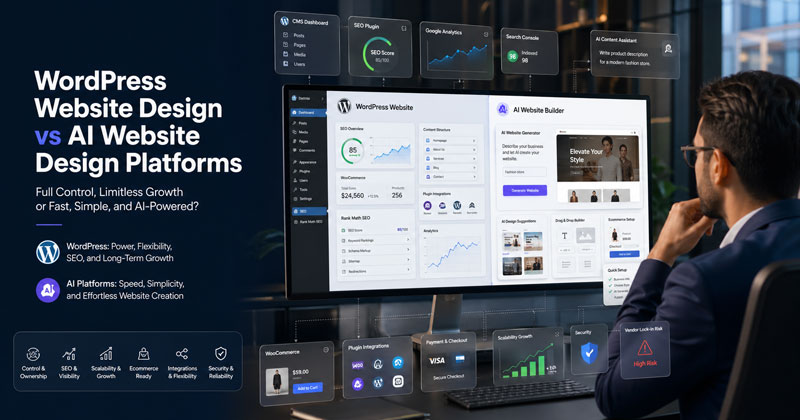
WordPress Website Design vs AI Website Design Platforms
Introduction
When building a business website today, two dominant approaches stand out: WordPress website design and AI-powered website design platforms.
WordPress is an open-source content management system (CMS) that allows businesses to build highly customizable websites using themes, plugins, and hosting providers of their choice. It powers a significant portion of the internet and is widely known for its flexibility and scalability.
AI website design platforms, on the other hand, use artificial intelligence to automatically generate websites based on user input. These platforms promise speed, simplicity, and minimal technical involvement by handling design, layout, and sometimes even content generation automatically.
Both approaches can produce professional websites — but they differ significantly in how they perform across business-critical areas such as SEO, content control, integrations, scalability, and security.
Below is a detailed, balanced comparison focused specifically on the factors that matter most to growing businesses.
1. Content Writing & Ease of Editing
WordPress Website Design
Pros
Full Content Control
WordPress provides complete control over page structure, formatting, and layout. Whether using the native block editor or visual builders, you can structure content exactly as needed.
Strong Blogging Capabilities
WordPress was originally built for blogging, making it exceptionally strong for content marketing. Categories, tags, custom post types, and editorial workflows are built-in.
Long-Form SEO Content Flexibility
For businesses focused on ranking on search engines, WordPress allows unlimited customization of headings, internal linking, embedded media, and structured formatting for long-form content.
Scalable Workflow
Multiple users, editorial roles, revision history, and content scheduling make it ideal for ongoing publishing.
Cons
- Requires some learning curve.
- Visual builders can sometimes become cluttered.
- Non-technical users may need training for advanced formatting.
AI Website Design Platforms
Pros
Extremely Easy Setup
AI platforms generate layouts instantly and often pre-fill content sections.
Beginner-Friendly Editing
Drag-and-drop editing is typically simplified and intuitive.
Built-In AI Content Tools
Many platforms offer AI-generated text suggestions to help fill sections quickly.
Cons
Limited Structural Control
Layouts are often locked into predefined structures, limiting custom formatting.
Weaker Blogging Systems
Blog features can be basic and lack advanced taxonomy or content structuring.
Reduced Flexibility for Long-Form SEO Content
AI builders may struggle with complex formatting, advanced internal linking strategies, or content hierarchy customization.
2. On-Page SEO & SEO Plugins
WordPress Website Design
Pros
Advanced SEO Plugins
WordPress supports powerful SEO plugins that allow granular control over meta titles, descriptions, schema markup, Open Graph tags, and more.
Full URL Structure Control
You can customize permalinks, categories, and slugs for optimal SEO structure.
Schema & Structured Data
Plugins allow custom schema for articles, products, FAQs, and services.
Image Optimization
Dedicated plugins allow automatic compression, lazy loading, and alt tag management.
Cons
- SEO effectiveness depends on proper setup.
- Plugins require updates and management.
AI Website Design Platforms
Pros
Built-In SEO Basics
Most AI platforms allow editing of meta titles and descriptions.
Automatic Optimization
Some platforms claim to automatically optimize content structure.
Cons
Limited Advanced SEO Control
Schema customization may be restricted.
Restricted URL Customization
Some platforms limit full control of URL structures.
Simplified Tools
Built-in SEO features may not offer deep technical optimization or structured data management.
3. Google Search Console Integration
WordPress Website Design
Pros
- Easy verification via HTML tag, file upload, or DNS.
- Full sitemap control.
- Access to structured data validation tools.
- Complete indexing control using SEO plugins.
Cons
- Requires manual setup.
- Must ensure sitemap configuration is correct.
AI Website Design Platforms
Pros
- Often simplified verification process.
- Some auto-generate sitemaps.
Cons
- Limited control over sitemap structure.
- Some restrictions on advanced indexing management.
- Structured data tools may not be fully accessible.
4. Google Analytics Integration
WordPress Website Design
Pros
Flexible Tracking Setup
You can integrate Google Analytics via plugins or manual code insertion.
Advanced Tracking Capability
Supports event tracking, ecommerce tracking, conversion tracking, and marketing pixels.
Custom Code Access
Full access to header/footer allows integration of advanced scripts.
Cons
- Requires setup knowledge.
- Improper implementation can affect data accuracy.
AI Website Design Platforms
Pros
- Simple Analytics integration via dashboard.
- Beginner-friendly tracking setup.
Cons
Limited Advanced Tracking
Some platforms restrict custom scripts or advanced event configurations.
Restricted Marketing Pixel Access
Certain AI builders limit full tracking flexibility.
5. Ease of Upgrades & Scalability
WordPress Website Design
Pros
Unlimited Feature Expansion
Ecommerce, memberships, booking systems, forums — all can be added via plugins.
Third-Party Integration
CRMs, marketing tools, automation platforms, APIs — integration is flexible.
High Scalability
Can grow from a simple brochure site to a full enterprise platform.
Cons
- Plugin conflicts can occur.
- Performance must be managed properly.
- Requires ongoing maintenance.
AI Website Design Platforms
Pros
- Built-in hosting and automatic updates.
- Simple upgrades within platform ecosystem.
Cons
Platform Limitations
You are limited to the features the platform offers.
Vendor Lock-In Risk
Migrating away can be difficult.
Less Flexibility for Complex Growth
May struggle to support advanced ecommerce or membership structures long-term.
6. Website Security
WordPress Website Design
Pros
- Security plugins available.
- Hosting provider choice.
- Backup solutions customizable.
Cons
Plugin Vulnerabilities
Poorly maintained plugins can create security risks.
Manual Responsibility
Updates and security monitoring require attention.
AI Website Design Platforms
Pros
- Platform handles hosting and updates.
- Built-in security measures.
- Automatic backups (on many platforms).
Cons
Limited Control
You rely entirely on the platform’s security standards.
Dependency Risk
If the platform changes policies or pricing, you have limited options.
Direct Comparison Table
Factor |
WordPress |
AI Website Platforms |
|---|---|---|
Content Control | Full customization | Limited layout flexibility |
Blogging | Advanced & scalable | Basic blogging tools |
On-Page SEO | Deep customization with plugins | Basic built-in tools |
URL Control | Full control | Sometimes restricted |
Search Console | Full integration control | Simplified but limited |
Analytics | Advanced tracking & pixels | Basic integration |
Scalability | Highly scalable | Limited to platform features |
Feature Expansion | Unlimited via plugins | Restricted ecosystem |
Security | Flexible but requires management | Managed by platform |
Vendor Lock-In | Low (portable) | Higher risk |
WordPress E-commerce (WooCommerce)
Capabilities
- WordPress combined with WooCommerce turns a WordPress site into a full online store.
- Native support for core ecommerce features like inventory management, product variations, coupons, shipping, tax options, subscriptions, digital products, and more.
- Supports multiple payment gateways (Stripe, PayPal, Apple Pay, Klarna, local gateways, etc.) with extensions.
- Allows deep customization of checkout flows, cart behavior, inventory rules, and sales flows using plugins or custom code.
Strengths
- Highly scalable for stores of virtually any size — from a few products to enterprise catalogs.
- Thousands of plugins allow advanced features like CRM integration, custom checkout fields, multi-currency support, enhanced shipping logic, marketplace setups, and more.
- Full control over data, store logic, and integrations — ideal for complex business requirements.
Considerations
- Requires more setup & maintenance (hosting, plugin updates, security hardening).
- Might need developer help for advanced customizations.
AI E-commerce Builders
AI website builders (including those with ecommerce functions) are evolving quickly — and many now support basic store features, including checkout and payment integration:
What AI Builders Can Do Today
Basic ecommerce workflow available
- Users can generate a store layout with products and descriptions powered by AI.
- Platforms can include built-in checkout pages where customers add products and complete purchase flows.
Payment gateway support
- Many AI builders come with integrated payment systems that support mainstream gateways such as Stripe and PayPal — ready to accept online payments without you needing to code any backend.
Simplified management
- Some platforms provide dashboards to manage products, pricing, orders, and customers without technical setup.
AI-assisted content
- Product titles, descriptions, and even SEO text can be generated through AI to save content creation time.
Limitations
Feature depth
- AI ecommerce tools today are strongest for small and simple stores (limited SKUs, basic variants, straightforward pricing).
- Complex store features like dynamic shipping calculators, advanced coupons, subscription models, multi-vendor marketplaces, or custom checkout pipelines may be limited or unavailable.
Scalability
- AI store builders are usually easier for beginners but can become limiting if your business grows or requires custom backend logic.
Customization constraints
- Unlike WordPress modules and plugin ecosystems, AI builders often work within a closed platform — you’re bound by what the vendor supports.
Quick Comparison
Feature |
WordPress + WooCommerce |
AI Ecommerce Builder |
|---|---|---|
Store Setup |
Manual setup required |
Automatically generated |
Product Management |
Full control |
Yes (simple UI) |
Payment Gateways | Multiple, flexible |
Yes (Stripe, PayPal, Basic built-in tools |
Advanced Ecommerce Logic |
Yes (subscriptions, shipping rules, tax logic) |
Limited |
Scalability |
Very High |
Moderate |
Custom Checkout Flows |
Full control |
Platform dependent |
AI-Generated Content |
Via add-ons |
Built-in |
Data & Code Control |
You own everything |
Platform restricted |
Bottom Line
AI ecommerce builders can absolutely create functional online stores complete with checkout functions and payment gateway integration — they’re especially great for quick setups and simple online shops.
❗ However, if your store needs advanced features, deep custom integrations, complex shipping/tax rules, multi-vendor systems, subscription billing, or deep performance tuning, then WordPress with a mature ecommerce solution like WooCommerce will offer far more flexibility and control.
Summary Recommendation
- 🛍️ Small shops or first-time sellers: AI ecommerce builders can get you selling fast without technical know-how.
- 📈 Growing or feature-rich stores: WordPress + WooCommerce is a stronger, more scalable choice long-term.
- 📊 Businesses needing advanced marketing, custom checkout, CRM integration, or bespoke UX: WordPress gives you maximum control.
Conclusion: Which Is Best for Your Business?
For Small Startups
AI website platforms can be attractive for early-stage businesses needing speed, simplicity, and low upfront costs. They are ideal for temporary landing pages, MVPs, or small brochure sites.
For Growing Businesses
WordPress becomes significantly more powerful as content marketing, SEO, analytics tracking, and integrations become important. Businesses that plan to grow typically benefit from the flexibility and expansion capabilities of WordPress.
For Long-Term Brands Focused on SEO and Scalability
WordPress is generally the stronger long-term solution. Its advanced SEO capabilities, content flexibility, structured data control, and unlimited scalability make it more adaptable to evolving digital marketing strategies.
Final Thoughts
AI website builders offer convenience, speed, and simplicity. WordPress offers control, flexibility, and long-term growth potential.
The right choice depends on your business goals:
- If speed and simplicity matter most → AI platforms may suffice.
- If SEO, scalability, advanced integrations, and full ownership matter → WordPress provides deeper control.
Ultimately, businesses planning to compete seriously in search rankings and scale their online presence should carefully evaluate not just how fast a website can launch — but how well it can grow.
Need a website built for long-term growth?
Choose a flexible, SEO-ready website design solution that gives your business more control, better scalability, and stronger online visibility.